Basildon sits squarely on the London Clay Formation, a stiff, over-consolidated clay that can be deceptively stable until you start cutting into it. We have logged enough boreholes across the Vange and Pitsea areas to know that the clay's fissured structure and the perched water tables in the overlying Bagshot Sands and gravel deposits create a real headache for earthworks design. A routine trial pit investigation can map the depth of weathered clay, but for any cut exceeding 3 metres adjacent to infrastructure, a rigorous slope stability analysis under Eurocode 7 Design Approach 1 is non-negotiable. Our lab's triaxial cells and shear boxes have processed hundreds of samples from the local Thanet Sand interface, giving us a solid baseline for effective stress parameters.
London Clay's fissured fabric means its field behaviour is governed by the aperture and persistence of joints, not just lab-derived peak strength parameters.
Methodology applied in Basildon
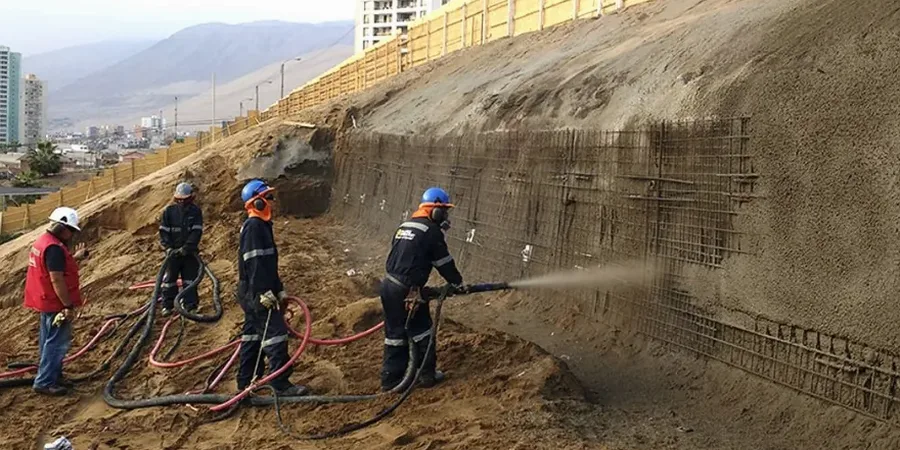
Risks and considerations in Basildon
We have seen too many near misses on Basildon construction sites where contractors assume a 45-degree batter will hold in London Clay. It might, for a few dry weeks in August. But the real danger kicks in when winter rainfall infiltrates those fissures, pore pressures spike, and what looked like a competent face suddenly slumps. The A127 corridor and the slopes around the Gloucester Park basin are textbook examples of this delayed failure mechanism. Ignoring pore pressure monitoring during earthworks is gambling with a material that has a well-documented history of progressive failure. The cost of a proper undrained and drained analysis upfront is trivial compared to the emergency works and regulatory scrutiny triggered by a slope failure near residential zones.
Our services
Our slope stability assessments for Basildon projects are built around a clear workflow: from site investigation planning to final design recommendations. We focus on the failure mechanisms that actually govern the local geology.
Limit Equilibrium and Finite Element Analysis
We carry out both traditional slice methods (Bishop, Spencer) and advanced FEM modelling to capture complex geometries, staged construction sequences, and soil-structure interaction. Our models incorporate the stiff, dilatant behaviour of intact London Clay alongside the softened, low-strength properties of the near-surface weathered zone. We also assess long-term, drained conditions where progressive failure along pre-existing fissures can govern the global stability of cuttings and embankments.
Site-Specific Parameter Derivation
Generic parameters from the London Basin geological memoir are not enough for design. We run high-quality triaxial compression tests (CIU and CID) on undisturbed U100 samples recovered from the critical failure surface depth. For the Thanet Sand interface, which often acts as a drainage path, we perform constant head permeability tests and direct shear tests to define the frictional resistance. The output is a defendable, site-specific geotechnical model ready for third-party review by NHBC or the local building control authority.
Common questions
What is the typical cost of a slope stability analysis for a site in Basildon?
For a single-family plot or small commercial site in Basildon, a full analysis including targeted boreholes, laboratory testing, and a report with design recommendations typically falls between £910 and £3,400. The final cost depends on the slope height, proximity to adjacent structures, and whether advanced laboratory testing (such as triaxial or ring shear) is needed to define residual strength parameters for the London Clay.
Do I really need a slope stability analysis for a small garden retaining wall?
If the wall retains more than 1.5 metres of soil or is located within 5 metres of a building or public highway, you will almost certainly need a formal design backed by a stability check. Basildon's building control officers are particularly cautious with London Clay because of its shrink-swell and softening behaviour. Even a small wall can fail if the backfill is not properly drained, and the analysis is the only way to confirm that the global stability (not just the wall's structural integrity) meets the required factor of safety.
How long does the analysis and reporting process take from start to finish?
A standard programme runs about four to five weeks from mobilisation of the drilling crew to the final report. This includes the site investigation phase (cable percussion or window sampling), laboratory testing on selected specimens (which typically requires a two-week curing and shearing period for triaxial tests), and the numerical modelling phase. We can fast-track the preliminary results within two weeks if you are facing a construction deadline, but the full design sign-off will depend on the availability of the test data.