Basildon's transformation from a cluster of villages into a major Essex new town after 1949 placed extraordinary demands on its road network. The A127 and A13 corridors carry heavy-goods traffic across the London Clay basin, where shrink-swell potential and variable Pleistocene head deposits create a pavement engineering challenge that flexible designs often fail to resolve. Our team approaches each rigid pavement design commission with a ground-model-first philosophy, integrating CBR road subgrade assessment data into concrete slab thickness calculations before a single joint layout is drafted. The geology across the borough, from the Bagshot Beds outcrops in the north to the alluvial clays flanking the River Crouch, demands this level of site-specific rigour.
Concrete pavement joint spacing in London Clay cuttings must account for a 40°C seasonal thermal range and a subgrade CBR that can swing from 1% to 5% between February and August.
Methodology applied in Basildon
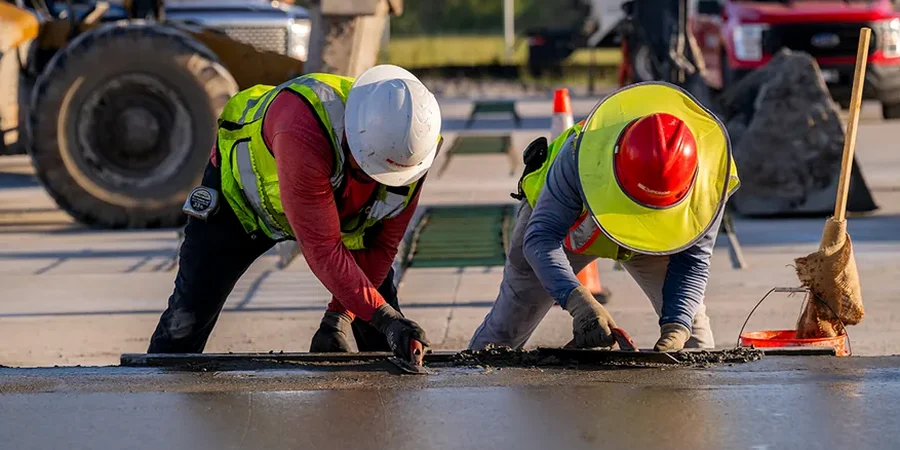
Risks and considerations in Basildon
On more than one Basildon site we have encountered made ground extending to 4 metres depth, a legacy of post-war land reclamation along the former Plotlands areas. Placing a rigid pavement over uncompacted fill without ground treatment guarantees differential settlement that manifests as corner cracks and faulted joints within the first two winters. Another local pattern: sulphate attack on cement-bound subbase where groundwater SO₃ exceeds 1,500 mg/l, a condition recorded in boreholes near the Burnt Mills industrial area. We mitigate this with sulfate-resisting cement (SRPC) in the subbase and a polythene separation membrane beneath the slab. Ignoring these site-specific hazards turns a 40-year design life into a maintenance liability within five.
Our services
Rigid pavement engineering in the Basildon district requires coordinated ground investigation and structural design. Below are the two core work packages we deliver for every concrete road project.
Foundation Class and Subgrade Treatment Design
We establish the subgrade stiffness class (Class 1 through 4 per CD 225) using dynamic plate load testing and laboratory CBR determination on Shelby tube samples from the London Clay. Where CBR falls below 2%, we design lime-stabilised capping layers or specify geogrid-reinforced granular platforms, calculating the composite modulus for input to the slab thickness model.
Joint Layout, Detailing and Construction Specification
Full jointing plan for JCP and CRCP pavements including transverse contraction joint spacing, dowel bar diameter and embedment length, tie bar schedules for longitudinal joints, and isolation joint detailing at structures. The specification package includes concrete mix design review for ASR mitigation, curing compound selection, and opening-to-traffic criteria based on maturity testing.
Common questions
What is the cost range for a rigid pavement design package in Basildon?
For a typical industrial access road or distribution centre yard in the Basildon area, our design fees range from £1,580 for a straightforward JCP overlay on a known subgrade to £4,870 for a full CRCP design with ground investigation interpretation, foundation class determination, joint detailing, and construction-phase support.
Why choose rigid pavement over flexible pavement for a Basildon logistics site?
Rigid pavements spread wheel loads over a wider area through slab action, which is advantageous on the medium-strength London Clay subgrades common in Basildon. They resist fuel and oil spillage degradation better than bituminous surfaces, a critical factor at lorry parking and refuelling areas. The 40-year design life with minimal mid-life intervention also suits owner-occupied industrial facilities where downtime for resurfacing is unacceptable.
How do you account for the shrink-swell behaviour of London Clay under a concrete pavement?
We control the risk through two lines of defence: a capping layer that extends below the zone of seasonal moisture fluctuation (typically 1.2 m depth in Essex) and a positive crossfall of 2.5% minimum that directs surface water away from the pavement edge before it can infiltrate the subgrade. For highly plastic clays with a Modified Plasticity Index above 40%, we specify a geotextile separator and increase the subbase thickness by 30%.
What laboratory tests do you require before starting the rigid pavement design?
We need a full suite including moisture content, Atterberg limits, particle size distribution by wet sieving, CBR at three compaction efforts (2.5 kg, 4.5 kg, and vibrated), and water-soluble sulphate and pH on a representative sample of the subgrade. For the concrete mix, we require a petrographic examination of the proposed aggregate source to assess alkali-silica reactivity potential, plus a 28-day flexural strength test programme on trial mixes.