Basildon's post-war New Town expansion drove rapid infrastructure development across the Essex clay plain, but the ground beneath those 1950s planners never made it easy. The London Clay Formation here sits interspersed with pockets of Lambeth Group sands, creating a patchwork of stiffness contrasts that tunnel boring machines really do not like. Our laboratory has processed undisturbed samples from dozens of Basildon boreholes, and the variance in undrained shear strength across a single site can swing from 40 to over 150 kPa within metres. For any tunnel alignment passing under the A127 corridor or near the town centre, a triaxial testing programme that captures both drained and undrained behaviour becomes the foundation of a credible face stability assessment — not a box-ticking exercise.
A single borehole transition from stiff London Clay to running Lambeth sand in under two metres is what drives 80% of urban tunnel settlement claims in Essex.
Methodology applied in Basildon
Risks and considerations in Basildon
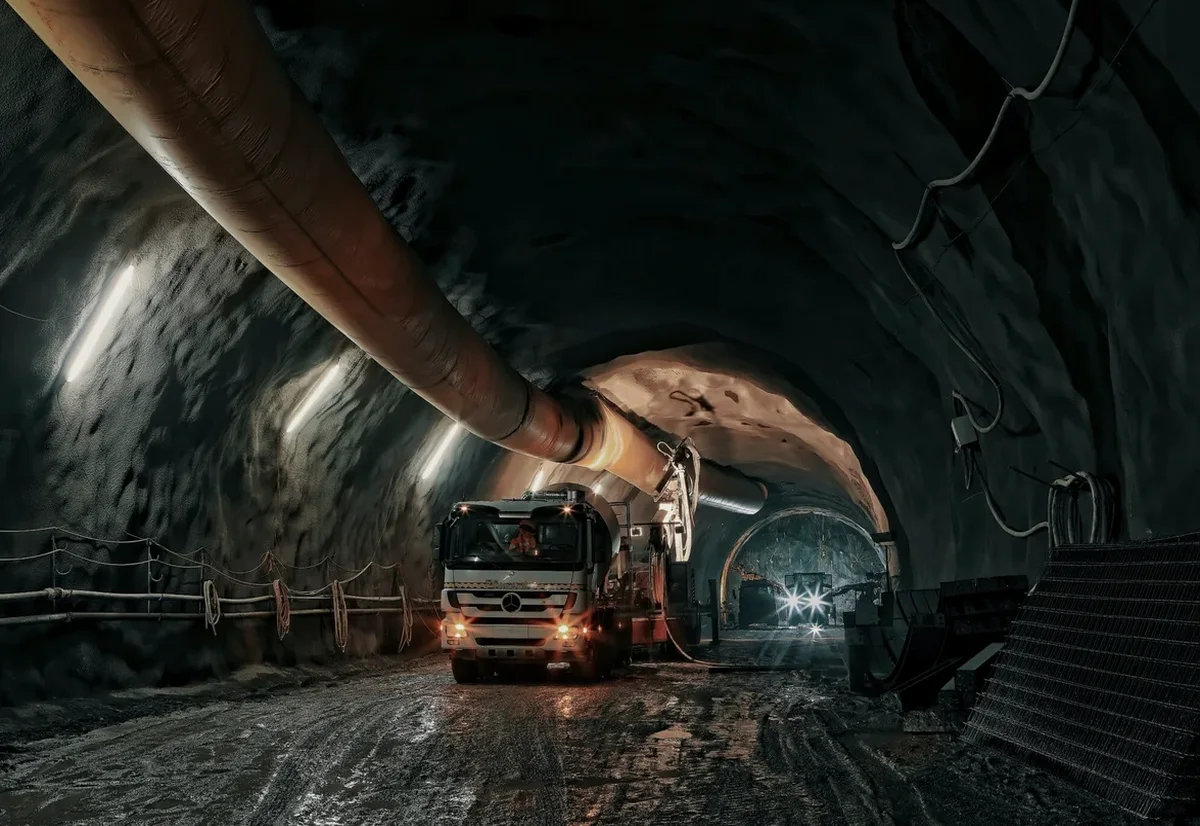
The contrast between the Vange and Laindon sides of Basildon is a textbook case in soft-ground tunnelling risk. Vange, sitting lower in the valley, brings you into soft alluvial silts and made ground overlying the Claygate Member — high compressibility, water-bearing lenses, and a real chance of face instability if support pressure drops even briefly. Laindon, on the higher terrace, hits stiff London Clay early, which sounds better until you encounter the sand partings that bleed groundwater into the excavation. We have seen a single borehole transition from competent clay to running sand in under two metres. Ignoring that transition zone during the ground model phase leaves the contractor blind to the exact hazard that causes the majority of settlement claims on urban tunnel projects in the Thames Basin.
Our services
We run the lab side of tunnel ground investigation with a focus on the parameters that actually govern TBM operation and segmental lining design in soft ground. Every test package is tailored to the geological unit encountered, because a generic suite tells you nothing useful about squeezing ground at the clay-sand interface.
Advanced Triaxial & Consolidation Testing
Consolidated-undrained and drained triaxial tests with pore pressure measurement on 100 mm undisturbed samples extracted from Shelby tubes. We report effective stress parameters (c', φ') and stiffness degradation curves essential for PLAXIS 3D models of Basildon's layered clay sequences, following BS 1377-8:1990 procedures.
TBM Slurry & Conditioning Compatibility Analysis
Atterberg limits, particle size distribution, and fall-cone testing on face material to design slurry mixes and foam conditioning agents. We quantify the clogging potential of the Lambeth Group clays — a notorious problem in this part of Essex — using the AFTES methodology so your EPB machine does not gum up 12 metres below ground.
Common questions
What laboratory tests are absolutely essential before launching a TBM in Basildon's ground conditions?
At minimum, a suite of multistage consolidated-undrained triaxial tests with pore pressure measurement on undisturbed samples from each distinct geological unit along the alignment. Pair that with oedometer consolidation tests to establish stiffness parameters for settlement prediction, and Atterberg limits plus particle size distribution to design the face conditioning programme. If the alignment crosses the Claygate-Lambeth boundary — as most Basildon routes do — we recommend adding fall-cone and dispersion testing to quantify clogging risk, which has caused serious downtime on previous Essex TBM drives.
How much does a full geotechnical laboratory programme for a soft-ground tunnel design cost?
For a typical Basildon tunnel ground investigation with 8–15 boreholes, a complete laboratory testing programme including triaxial, oedometer, index, and chemical testing generally falls between £3,790 and £13,480 depending on the number of samples, the testing frequency required by the design stages, and whether specialist tests like residual strength ring shear or slurry compatibility analysis are included.
Why does the Claygate Member cause so many problems for tunnel designers compared to the London Clay?
The Claygate Member is a transitional unit between the underlying stiff London Clay and the overlying sandy Bagshot Beds. It behaves inconsistently — stiff enough to stand unsupported for short periods, but with silt and fine sand partings that allow groundwater ingress and rapid strength loss upon remoulding. Standard London Clay design assumptions do not transfer across: the constrained modulus is typically lower, and the undrained shear strength can degrade by 40–50% with small strain softening. Our laboratory programme isolates these specific parameters so the numerical model reflects the real material behaviour, not a regional assumption.