Basildon sits on a patchwork of London Clay, Thanet Sand, and Quaternary Terrace Gravels — a mix that makes uniform foundation assumptions risky. The water table across the borough often sits just 2 to 4 metres below ground level, particularly near the Crouch and Thames tributaries. We design shallow foundations that account for this variability, checking bearing capacity and settlement against the specific strata logged on each plot. A test pit investigation reveals the near-surface sequence quickly, while Atterberg limits testing on the clay fraction confirms the shrinkage and swelling potential before we finalise footing dimensions. This desk-and-field pairing stops surprises during excavation.
On Basildon's London Clay, allowable bearing pressure is rarely the limiting factor — differential settlement across the footprint almost always governs the design.
Methodology applied in Basildon
Risks and considerations in Basildon
On Basildon's clay slopes — particularly across the Langdon Hills and the upper Crouch valley — we regularly encounter a thin colluvial veneer over weathered London Clay. This layer can mask a shallow slip plane if the cut is benched too steeply for the foundation trench. Another recurring issue is tree-induced desiccation: mature oak and poplar within the zone of influence can shrink the clay to depths beyond 2 metres, requiring deeper trench-fill or suspended floor solutions. Ignoring the BRE Digest 298 guidance on vegetation proximity is the single most common cause of superstructure cracking we see in the borough. Where the natural ground falls away across the site, we step the footings and check global stability using a slope stability analysis to confirm the lower-level excavation does not unload the upper pads.
Our services
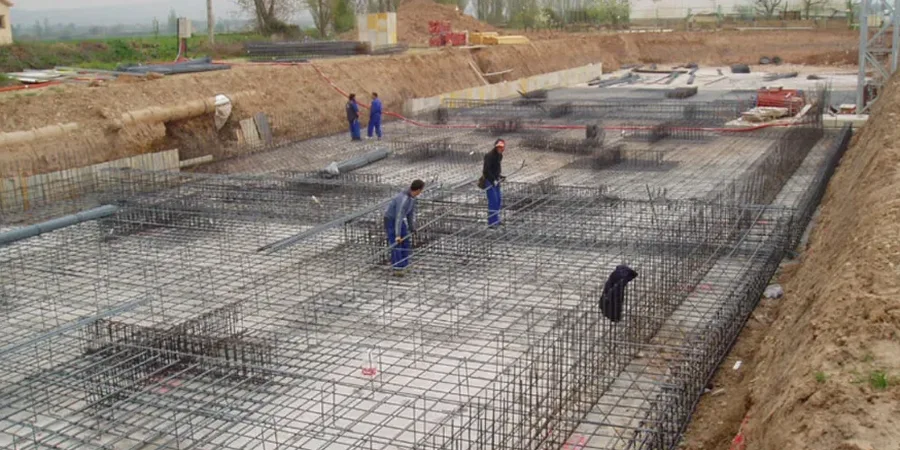
Our shallow foundation scope in Basildon covers the full chain from factual site data to construction-ready drawings. We keep the report concise — no padding.
Bearing capacity and settlement calculations
Analytical and numerical checks for strip, pad, and raft configurations on natural ground or engineered fill, using laboratory-measured strength and stiffness parameters.
Foundation construction drawings and reinforcement schedules
CAD output showing footing layout, step details, trench-fill specifications, sulfate-resistant concrete class, and blinding requirements per BS 8500.
Common questions
What ground investigation data do you need before designing a shallow foundation in Basildon?
We need at least one exploratory point per 250 square metres of footprint, logged to a depth of 3 metres or 1.5 times the footing width (whichever is greater). For clay sites, we require Atterberg limits, undrained shear strength from triaxial or hand-vane tests, and sulfate/sulfide chemical analysis per BRE SD1. On gravel sites, particle size distribution and SPT N-values from a window sampler borehole are normally sufficient.
Can you design a shallow foundation on made ground in Basildon?
It depends on the thickness and nature of the fill. If made ground is less than 600 mm thick and underlain by competent natural strata, we often specify removal and replacement with engineered granular fill, then design the footing on the replacement layer. For deeper fills, we may recommend ground improvement or switch to a piled solution. The decision hinges on the site investigation logs and the sensitivity of the structure to settlement.
How much does a shallow foundation design package cost for a typical Basildon residential project?
For a single residential plot with standard ground conditions, the design package typically falls between £1,450 and £2,850, depending on the complexity of the site geometry, number of stepped footings, and whether tree influence zones require deeper trench-fill detailing.
How do you handle the tree influence zone when designing footings on London Clay in Basildon?
We plot the mature tree locations on the site plan and apply the NHBC Chapter 4.2 and BRE Digest 298 guidance to calculate the required depth below the zone of desiccation. For high-water-demand species like oak or poplar within 1.2 times the mature height of the proposed footing, the foundation depth can exceed 2.5 metres. In those cases we compare the cost of deep trench-fill against a suspended ground-floor solution and present the client with a clear recommendation.