The contrast between the stiff, overconsolidated London Clay that caps the northern estates of Basildon and the softer alluvial silts encountered near the Crouch estuary tributaries defines much of the local geotechnical risk. A borehole log might show a brown silty CLAY in Laindon and a grey slightly sandy CLAY just two miles south in Pitsea, yet the behavioural difference under load or moisture change can be substantial. Quantifying that difference requires the Atterberg limits — the liquid limit and plastic limit that together frame the plasticity window in which a fine-grained soil can deform without cracking. For earthworks specification, shrinkage-heave assessment, and the selection of formation levels, these index tests remain the most cost-effective triage tool available. When we run them alongside a grain size analysis on the same disturbed sample, the combined dataset lets the design team classify the material to BS 5930:2015+A1:2020 and assign appropriate design parameters without waiting for strength tests.
A five percentage point shift in the liquid limit of a Basildon clay can change its earthworks classification from suitable to unacceptable — these small numbers carry large contractual consequences.
Methodology applied in Basildon
Risks and considerations in Basildon
A cut-and-fill operation on the western edge of Basildon, where a developer was benching into a weathered London Clay slope to create a plateau for light industrial units, exposed the hazard of working without plasticity data. The contractor assumed the brown clay was stiff and free-draining based on visual inspection of the trial pit walls. After three weeks of February rain, the upper two metres softened to a consistency approaching the liquid limit; the haul roads became impassable and a section of the temporary batter slumped overnight. Post-incident testing in our laboratory returned a plasticity index of 28 percent and a liquidity index close to 0.9 at the failure surface — the material had been operating within 3 percent moisture of its liquid limit. Had the earthworks specification been informed by Atterberg limits from the ground investigation phase, the contractor could have programmed winter working restrictions and specified lime stabilisation for the cut face. The delay cost six figures, but the lesson was simpler: plasticity is not a secondary index when you are excavating in Essex during the wet season.
Our services
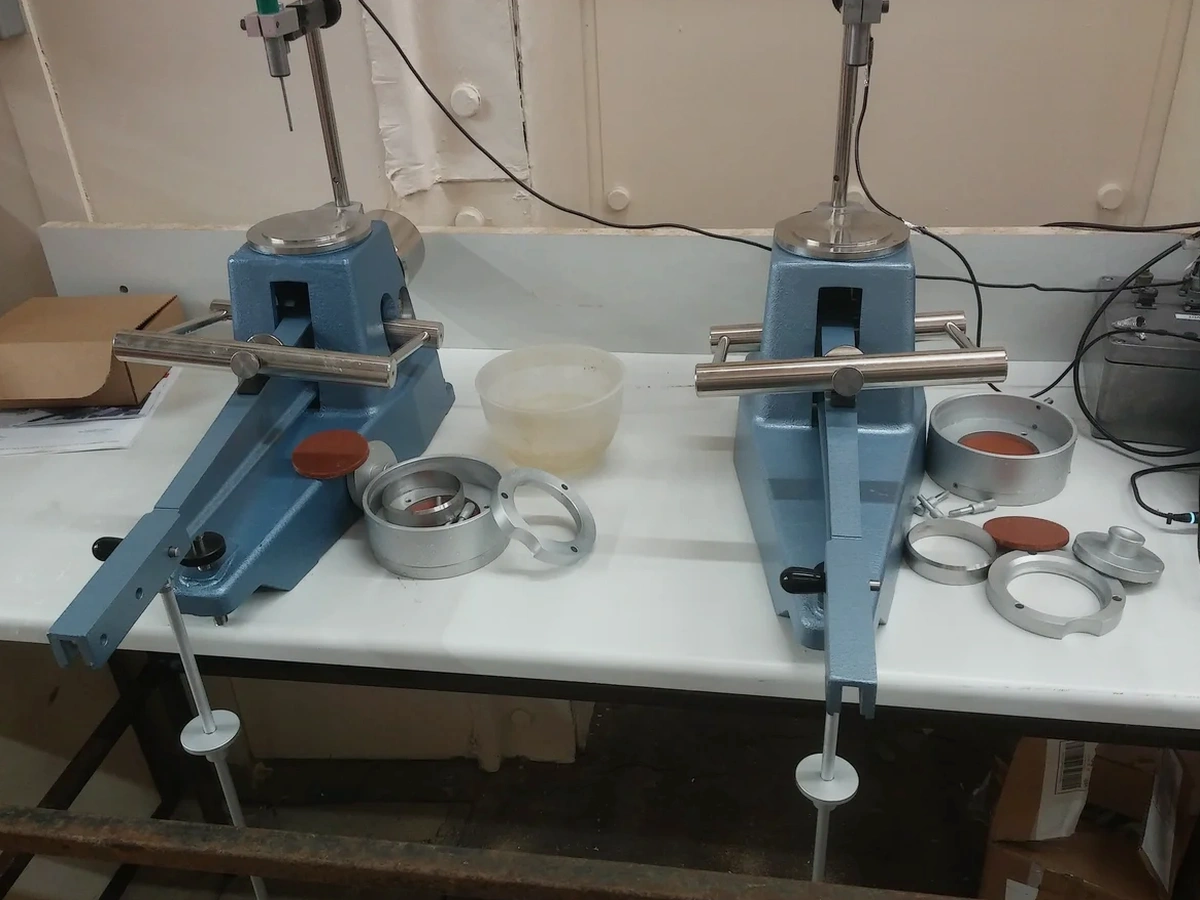
Our Basildon laboratory provides Atterberg limits as part of a structured soil classification workflow that supports earthworks specification, foundation risk assessment, and statutory compliance. Each test package is tailored to the project stage and the expected ground conditions.
Basic classification suite
Liquid limit, plastic limit, and plasticity index on up to five specimens per sample, suitable for routine site investigation and NHBC submissions on shrinkable clay sites.
Moisture condition profiling
Natural moisture content plus Atterberg limits on a depth profile, enabling liquidity index calculation and identification of softened zones that may require over-excavation or stabilisation.
Expedited earthworks support
24-hour turnaround on classification tests for active earthworks operations where weather conditions are changing the material state and specification compliance is time-critical.
Frequently asked questions
What do Atterberg limits actually measure in a fine-grained soil?
The liquid limit is the moisture content at which a soil transitions from a plastic state to a liquid state, determined in the UK using the cone penetrometer method where an 80 g, 30° cone achieves 20 mm penetration. The plastic limit is the moisture content at which the soil can no longer be rolled into 3 mm diameter threads without crumbling. The plasticity index, their difference, defines the range of water contents over which the soil behaves plastically. These are index properties that classify the soil and predict its engineering behaviour — they do not measure strength directly, but a high PI combined with a high natural moisture content is a reliable indicator of soft, compressible, and potentially shrinkable ground.
What do Atterberg limits testing cost for a Basildon project?
A standard set of liquid limit and plastic limit determinations on a single disturbed sample costs between £60 and £70, with volume discounts applying when multiple samples are submitted as part of a larger ground investigation. Expedited reporting within 24 hours carries a modest surcharge. The final cost depends on the number of specimens per sample and whether the work is packaged with other classification tests such as particle size distribution.
Can Atterberg limits identify shrinkable clay under the NHBC Standards?
Yes. NHBC Standards Chapter 4.2 uses the plasticity index as the primary indicator of shrink-swell potential. A PI greater than or equal to 10 percent classifies the soil as shrinkable, with the foundation depth requirements increasing through the medium (PI 10–20%), high (PI 20–40%), and very high (PI >40%) categories. In Basildon, where the London Clay typically yields PI values between 20 and 35 percent, most residential foundations must be designed for medium to high shrinkage risk, and the Atterberg results form the basis for the foundation depth calculations submitted to Building Control.